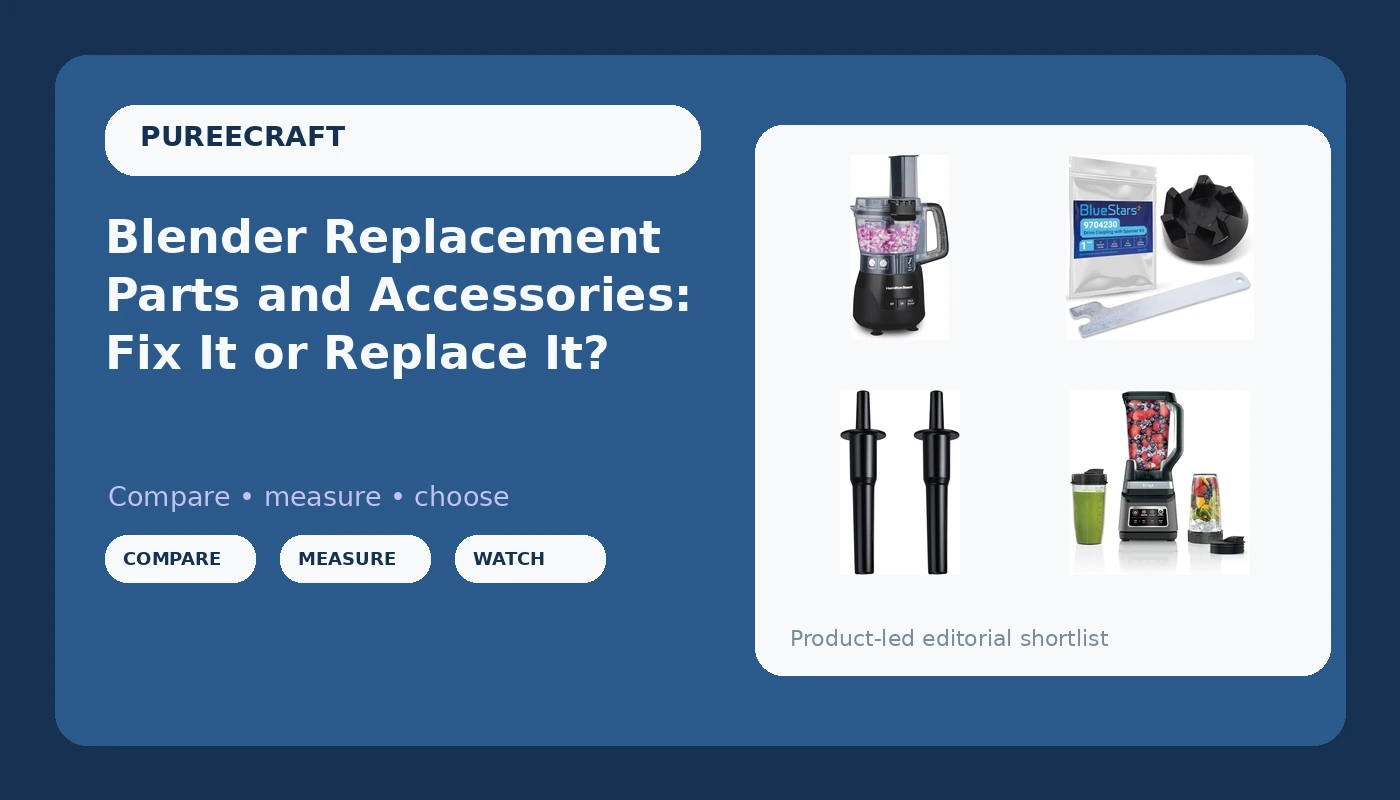
A blender rarely dies all at once. It starts to smell hot, the jar wobbles on the base, the blades spin but nothing moves, or a thick blend stalls with the tamper stuck an inch above the bottom. When that happens, the useful question is not which machine is the best one on the market. It is whether blender replacement parts and accessories can put the machine you already own back to work, or whether the money is better spent on a new base. This explainer covers both sides of that line with four products that show up most often in the decision: a full-size machine that handles family batches and single servings, the drive coupler that fails first on a KitchenAid base, the tamper that makes thick blends possible at all, and a compact chopper for the small jobs a tall jar handles badly.
Related: Blender Jar Geometry Explained: Why Shape Beats Wattage →
Quick answer
Most blender failures that feel fatal are mechanical and cheap to fix. A drive coupler, a worn gasket, or a missing tamper can bring a perfectly healthy motor back into service, and those parts cost a fraction of a new machine. Replace the whole blender when the motor itself is the problem: a burning smell from the base, grinding noises that follow the motor rather than the jar, or a shaft that no longer spins true. The four products below cover both sides of that decision.
4 useful options
| Model | Best fit | What stands out |
|---|---|---|
| Ninja BN751 Professional Plus DUO Blender | Households that want one base for big batches and single servings | 1400 peak watts, 3 Auto-IQ programs, a 72-oz Total Crushing Pitcher and two 24-oz to-go cups in the box |
| Ultra Durable 9704230 Blender Drive Coupler with Spanner Kit by BlueStars | KitchenAid KSB5WH, KSB5, and KSB3 owners with a base that runs but will not blend | Replaces WP9704230VP and WP9704230, and ships with the spanner needed for the swap |
| 2-Pack Blender Replacement Tamping Tool for Vitamix classic Standard 64oz containers | Anyone fighting thick blends in a classic Vitamix jar | Two tampers sized for the standard 64-oz container, so a spare stays in the drawer |
| Hamilton Beach Stack & Snap 4-Cup Mini Food Processor & Vegetable Chopper | Small chopping jobs, sauces, and kitchens short on counter space | A 4-cup bowl with a stack-and-snap assembly instead of a twist-lock alignment |
Complete machine: Ninja BN751 Professional Plus DUO Blender
The interesting part of this package is not the wattage number. It is that the same base drives a 72-ounce pitcher and a 24-ounce cup, which is the arrangement most households actually need and few machines actually offer. A large pitcher is the right tool when you are blending for four people or batch-cooking a sauce. It is the wrong tool when you want one smoothie, because a wide jar with a small load leaves ingredients sitting outside the blade path. The to-go cups solve that by narrowing the working volume.
The trade-off is that cups and lids are consumables. Gaskets go missing, lids crack, and the cup you blend in is the cup you have to remember to bring home. Auto-IQ programs take the timing decision out of your hands, which helps consistency but also means you are trusting the machine's pulse pattern rather than your own eye on the texture. For a household blending most days, that trade is usually worth it.
Repair part: Ultra Durable 9704230 Blender Drive Coupler with Spanner Kit by BlueStars
A drive coupler is the small rubber or plastic piece that transfers rotation from the motor shaft up into the blade assembly. It is deliberately the softest link in the chain. When a blade jams on a frozen block or a thick paste, the coupler strips or rounds off instead of the motor burning out. That design choice is why a machine that suddenly spins without blending is usually not a dead machine. It is a ten-minute repair.
The symptoms are consistent. The motor runs and sounds normal, the blades do not turn, and there may be a faint rubber smell or a visible flat spot on the coupler's splines. Before ordering anything, write down the model number printed on the base and check it against the compatibility list, because coupler splines differ between blender families even when the machines look similar. This listing covers the KitchenAid KSB5WH, KSB5, and KSB3, and includes the spanner for the swap. If your base carries a different model number, that is a mismatch worth taking seriously rather than forcing.
Thick-blend tool: 2-Pack Blender Replacement Tamping Tool for Vitamix classic Standard 64oz containers
The tamper is the most misunderstood tool in the blender drawer. It is not an accessory for weak machines. It is what makes thick blends possible on strong ones. Nut butter, frozen fruit with no added liquid, hummus, and thick smoothie bowls all sit above the blades and refuse to circulate on their own. Without a tamper, the usual fix is to pour in more liquid, which changes the recipe from a bowl to a drink. With a tamper, you press the mixture into the blade path while the motor runs and keep the texture where you wanted it.
This is a third-party accessory, not a Vitamix-branded part, and it is sized for the classic standard 64-ounce container rather than every container in the lineup. Confirm your jar before ordering. The two-pack matters more than it looks: tampers get left in sinks, borrowed, and misplaced, and a thick-blend machine without its tamper is a machine you stop using for thick blends.
Small-batch alternative: Hamilton Beach Stack & Snap 4-Cup Mini Food Processor & Vegetable Chopper
A 72-ounce pitcher cannot make a cup of pesto. This is the practical argument for keeping a small appliance alongside a big blender. Small quantities of herbs, nuts, breadcrumbs, or aromatics sit under the blades of a wide jar and never get pulled into them. A 4-cup bowl puts the blades close enough to the food that the work actually happens.
The stack-and-snap design is a real usability difference, not a marketing phrase. Twist-lock assemblies require lining up tabs and turning the bowl until it seats, and they are a common source of "why is this not starting" moments when the bowl is a few degrees off. Stack-and-snap removes that step. The trade-off is capacity. This is a chopper and mini processor, not a smoothie machine, and it should be judged on prep work rather than on ice crushing or frozen fruit.
Prices and availability may change. Product images, names, and retailer links must be matched by verified ASIN. Do not state a current price, rating, stock status, or measured result without current evidence.
Wattage is a number, jar geometry is the machine
Blender marketing leads with watts because watts are easy to print on a box. Watts describe how much power the motor can draw, not how well the machine moves food. A 1400-watt motor bolted to a jar that cannot funnel ingredients into the blade path will still leave frozen fruit spinning in place. A weaker motor paired with a narrow jar and a good blade stack often produces a smoother result.
Three things matter more than the number on the box. The first is jar geometry: the shape of the walls and the taper toward the blades determine whether a thick mixture collapses back into the blade path or parks itself on the side. The second is blade design, since a stacked blade assembly and a single four-point blade do different jobs and clear different ingredients. The third is the soft parts, meaning couplers, gaskets, and seals. These are the components that actually fail in normal use, and they are also the components nobody advertises.
This is why the repair-or-replace question is usually not about power. If a machine has good jar geometry and a healthy motor, a stripped coupler is a minor event. If the jar is the problem, no replacement part will fix it, because the part that needs changing is the design.
How to decide between a part and a new blender
- Identify where the failure lives. Unplug the base, fit an empty jar, and see whether the motor spins and the blades do not. Motor turning with stationary blades points at the coupler or the blade assembly. Motor silent points at the base, the switch, or the cord.
- Check the cheap parts first. Couplers, gaskets, seals, and jar bases are the parts that wear. Look for a flat spot, a stretched seal, or a jar base that rocks when set on a flat surface.
- Verify the model number against the part listing. Compatibility lists are specific for a reason, and a coupler that nearly fits will strip again quickly.
- Compare the part against the class of machine you would buy to replace it. If a small part restores a machine you already like, the math usually favors the part.
- Ask what you actually blend. If your recipes have outgrown the jar, or if you need to-go cups the machine does not offer, repair keeps a limitation in place.
What to keep on hand
- Keep a spare coupler if you own a KitchenAid KSB-series blender, since it is the wear item in that drivetrain.
- Keep a tamper within reach of the base, not buried in a drawer, or thick blends will get thinned out with extra liquid.
- Hand-wash gaskets and check them for stretching, because a gasket that no longer seals causes leaks that look like a bigger failure than they are.
- Add liquid gradually when starting a thick blend rather than dumping it in at the top, since the blades need something to circulate.
- Match the container to the job: big pitcher for batches, narrow cup for one serving, small bowl for chopping and pastes.
Which option should you choose?
Choose the Ninja BN751 Professional Plus DUO Blender when you want a single base that covers family-size batches and single servings, and you would rather have to-go cups included than buy them separately. Choose the Ultra Durable 9704230 Blender Drive Coupler with Spanner Kit by BlueStars when your KitchenAid KSB5WH, KSB5, or KSB3 base runs but the blades do not turn, and you have confirmed the model number matches. Choose the 2-Pack Blender Replacement Tamping Tool when your thick blends stall in a classic standard 64-ounce container and you are tired of adding liquid to fix it. Choose the Hamilton Beach Stack & Snap 4-Cup Mini Food Processor & Vegetable Chopper when your real problem is small-batch prep, not blending, and a full-size pitcher is simply the wrong shape for the job.
One caveat applies to all four. This article relies on manufacturer specifications, listed compatibility, and general blender mechanics rather than independent laboratory testing. Compatibility lists can change, and a part that fits one revision of a model may not fit another, so confirm your specific model number before ordering.
The bottom line
Blenders fail in predictable places, and most of those places are cheap. The drive coupler strips, the gasket stretches, the tamper goes missing, and the machine gets blamed for all three. If the motor still runs and the jar still fits the base, a small part is usually the honest answer. If the jar design is what is holding you back, or you need a machine that switches between a big pitcher and a single serving, that is a replacement question and no accessory will answer it. Judge the machine by how it moves food, keep the soft parts in stock, and keep the tamper where you can reach it.